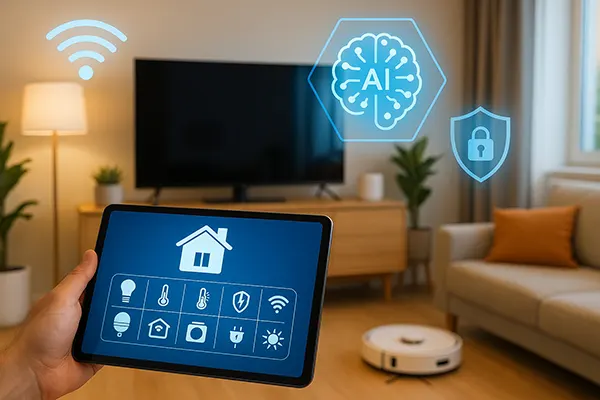
AI-Driven Predictive Maintenance and Home Automation: Key Innovations in 2025
Artificial intelligence has become a central component of modern homes, changing how households monitor equipment health, manage energy, and automate everyday routines. In 2025, the focus has shifted toward practical, reliable, and transparent AI tools that reduce costs, enhance efficiency, and extend the lifespan of domestic systems. The following overview explores the most relevant advances and explains how they reshape real-life household management.
Evolution of Predictive Maintenance in Smart Homes
Predictive maintenance in 2025 is no longer limited to basic fault detection. Modern AI models analyse real-time sensor data, long-term usage patterns, and environmental conditions to anticipate mechanical failures before they occur. This approach significantly reduces downtime and helps homeowners prevent costly repairs by acting at the earliest sign of risk.
Heating and cooling systems, boilers, and home energy units now use embedded machine-learning chips that run diagnostics continuously. Instead of waiting for visible symptoms, such as noise, reduced performance, or increased consumption, the system identifies hidden inefficiencies and recommends targeted adjustments. Manufacturers have reported a measurable decrease in emergency service calls as AI diagnostics become more accurate.
Another major improvement involves interoperability. Appliances from different brands communicate through unified machine-learning interfaces. These shared protocols ensure consistent data flow between devices, allowing AI models to produce more precise predictions based on collective household activity rather than isolated readings.
How AI Models Improve Reliability and Safety
The reliability of predictive maintenance depends heavily on the quality of training data. In 2025, systems increasingly rely on real-world datasets collected from millions of anonymised devices. This ensures that models understand genuine failure patterns, extreme load scenarios, and regional factors such as humidity or seasonal climate changes.
Safety has improved thanks to multi-layered alert systems. When an appliance shows signs of potential malfunction, AI sends early warnings, predicts the severity of the issue, and offers clear recommendations. For example, a home energy storage system can notify the user when a battery cell shows abnormal thermal activity, reducing the risk of overheating.
Another contribution to safety comes from AI-driven self-correction. Devices adjust their internal parameters automatically to prevent further degradation. This might include lowering water pressure in a boiler, reducing output in a ventilation system, or changing charging cycles in energy units to prolong component life.
AI Automation for Everyday Domestic Routines
AI technologies are deeply integrated into household routines, offering automation that feels more personal and accurate than ever. Instead of fixed schedules, systems adapt to user behaviour, daily patterns, and real-time activity. This creates a seamless environment where lighting, energy usage, cleaning devices, and climate control adjust themselves without manual intervention.
Lighting systems now adjust based not only on time of day but also on circadian rhythm data, weather conditions, and user productivity needs. This level of personalisation helps reduce energy waste and creates more comfortable living conditions. The automation is subtle and responsive, avoiding abrupt changes.
Domestic robots have gained significant improvements in pathfinding, obstacle recognition, and precision. Whether vacuuming, lawn care, or window cleaning, these devices rely on new spatial intelligence models that understand room layout, furniture movement, and human activity patterns. Their actions feel less random and more aligned with household expectations.
Energy Efficiency Through Intelligent Adaptation
Energy management is one of the most visible use cases for AI in 2025. Systems track consumption across all household appliances, optimising output and suggesting improvements. Rather than simply reducing usage, AI focuses on balancing comfort, cost, and long-term device health.
Solar energy users benefit greatly from predictive optimisation. AI can forecast production levels based on weather data and schedule appliance cycles accordingly. For example, washing machines or charging stations may operate during peak sunlight hours to lower costs and preserve battery cycles.
Smart meters provide detailed breakdowns of usage patterns, allowing homeowners to make informed decisions. These insights are based on accurate, contextual analysis rather than general estimations, giving users more control over their environmental impact and monthly expenses.
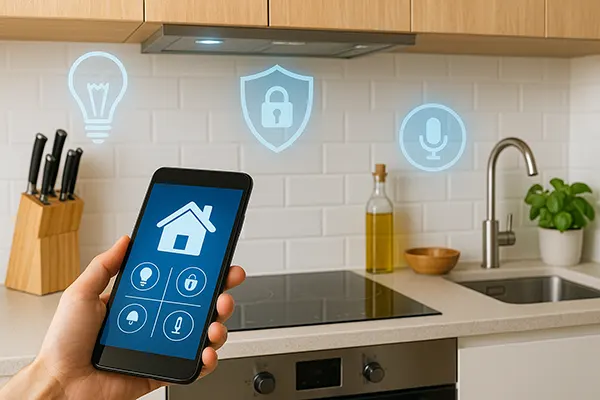
New Standards and Ethical AI in Home Automation
With AI becoming essential in domestic environments, industry standards in 2025 place strong emphasis on transparency, data protection, and user autonomy. Manufacturers follow strict rules to ensure that predictive models operate ethically and that homeowners understand how these systems make decisions.
AI providers now include clear documentation explaining model behaviour, training methods, and data handling policies. This approach allows users to evaluate the reliability of their systems and understand how recommendations are generated. Transparent operation encourages trust and ensures that the technology remains user-centred.
Ethical guidelines also cover data collection. Devices use anonymisation protocols, local processing options, and encrypted communication to minimise risks. Users may choose what type of information to share, and many systems are designed to function offline when necessary. These measures aim to protect privacy while maintaining a high level of functionality.
Impact on Customer Support and Service Quality
Predictive maintenance reduces the need for emergency service calls, but it also reshapes customer support. Service teams now receive diagnostic reports generated by the AI system, allowing technicians to arrive with the correct tools, components, and context. This shortens repair times and reduces repeat visits.
Remote support has become more effective as technicians can access live system data through secure channels. Users receive step-by-step guidance for minor issues without waiting for in-person appointments. This approach saves time and increases efficiency both for the homeowner and the service provider.
Warranty management has improved because AI produces objective records of device performance. This allows companies to assess causes of malfunction more accurately and helps prevent disputes. As a result, the overall experience becomes more consistent and dependable for users.