Digital Identities for AI Agents: How HashiCorp Vault Restricts Access to Corporate Systems
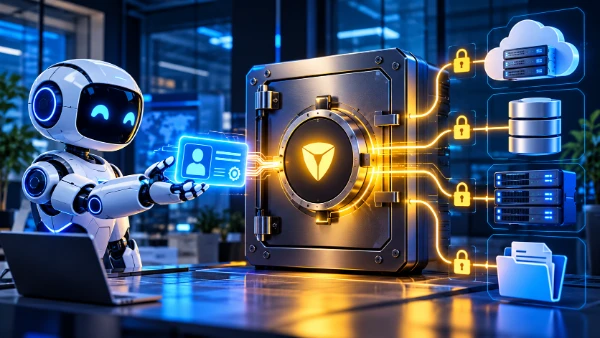
AI agents are becoming active participants in corporate IT operations. They can retrieve documents, analyse customer records, update databases and interact with business applications without requiring human intervention for every action. However, giving an autonomous agent access to company resources introduces security risks that traditional user accounts were not designed to address. An agent needs a verifiable digital identity, clearly defined permissions and credentials that can be withdrawn when its work is finished. HashiCorp Vault addresses these requirements through identity management, controlled authentication, access policies and temporary credentials. By 2026, its capabilities also include dedicated identity and authorisation mechanisms for agentic AI workflows, allowing organisations to distinguish approved agents from ordinary applications and restrict the resources they can access.
Why AI Agents Need Separate Digital Identities
Traditional corporate access management is largely organised around employees, departments and software services. A member of the finance team receives permissions appropriate to their responsibilities, while an application might use a service account to connect to an internal database. AI agents complicate this arrangement because they can independently decide which authorised tools to use and which steps to perform. A customer support agent might need to check an order, retrieve delivery information and prepare a refund request within a single workflow. These activities involve different corporate systems, each containing information with its own sensitivity level. Allowing the agent to operate under a general administrator account would expose far more information than its assigned task requires.
A digital identity provides a way to distinguish one agent from another and establish which permissions belong to each automated workload. Rather than sharing a single API key across an entire AI application, organisations can associate agents with individual identities or controlled workload identities. This distinction becomes particularly important when several agents work together. A reporting agent might only need read access to selected financial records, whereas an inventory management agent may need permission to update stock information. Separate identities make it possible to establish different access rules, investigate unexpected activity and remove permissions without disrupting unrelated services. They also help security teams determine whether an action originated from an approved automation process.
HashiCorp Vault acts as a central authority for managing access to secrets such as database passwords, API credentials and encryption keys. Its authentication methods allow applications and workloads to establish their identities before receiving permission to access protected information. Vault can integrate with external identity systems and infrastructure environments, including Kubernetes and major cloud providers. It also supports JWT-based authentication, allowing a workload to present a signed token issued by a trusted identity provider. Vault verifies the token and checks configured restrictions before assigning the permitted access policies. Importantly, a Vault identity does not automatically grant unrestricted access to every connected corporate service. The permissions ultimately available to an agent also depend on the credentials issued, the configuration of the destination system and the controls applied by the application.
How Vault Verifies an AI Agent Before Granting Access
Authentication begins when an agent or the service running it presents an accepted form of identity evidence. Depending on the deployment, this might involve a Kubernetes service account token, a cloud workload identity or a signed JSON Web Token. With JWT authentication, Vault can validate the token’s signature against trusted signing keys and examine information such as its issuer, intended audience and subject. These checks help establish that the credential originated from an approved source and was intended for the configured authentication process. Administrators can also restrict authentication to particular claims, such as an application identifier or deployment environment. Consequently, a token issued to one workload does not have to provide access to another workload’s Vault role.
Vault maintains an internal identity system built around entities and aliases. An entity represents an identity known to Vault, while aliases associate authentication records with that identity. This arrangement can provide consistent identity management when a workload uses different supported authentication methods. After successful authentication through a conventional method, Vault generally issues a token associated with applicable policies. Those policies determine which Vault operations the identity can perform. For example, an AI document-processing service might receive permission to read credentials for an approved document repository but not credentials belonging to the payroll database. The token’s lifetime and permitted operations can be limited so that access remains appropriate to the service’s responsibilities.
In 2026, Vault Enterprise 2.1.0 and later also provides Agentic IAM capabilities specifically designed for autonomous agents. Its Agent Registry allows organisations to register approved agents and associate governance restrictions with their identities. A built-in OAuth resource server can validate externally issued OAuth 2.0 JWT access tokens and check whether the relevant identity has an active agent registration. Under this model, an approved agent can authenticate using its OAuth credential without first obtaining a conventional stored Vault token. Vault evaluates the presented credential on each request, including the applicable identity and authorisation restrictions. These capabilities require an appropriate Vault Enterprise licence and should not be confused with the standard authentication features available in other Vault editions.
How HashiCorp Vault Limits AI Agent Permissions
Confirming an agent’s identity is only the first stage of securing its activities. The next requirement is determining what that identity may actually do. Vault uses policy-based access controls to define permissions for specific paths and operations within Vault. Administrators can allow a workload to read one group of secrets while preventing it from changing or deleting them. This approach follows the principle of least privilege: each identity receives only the access necessary for its assigned responsibilities. Consider an AI agent that prepares weekly sales reports. It might need temporary credentials for a reporting database, but it has no operational reason to access production payment credentials or modify customer account balances. Separate Vault policies help enforce these boundaries at the credential-management level.
Vault policies can distinguish between operations such as reading, creating, updating, listing and deleting resources. They can also explicitly deny access, depending on the configured policy rules. This makes it possible to establish narrow permissions for individual automated services instead of assigning broad administrative roles. For instance, a company could configure a document classification agent to retrieve an API credential for an approved storage service while preventing access to unrelated application secrets. Policy design should account for the difference between reading a secret in Vault and using that secret elsewhere. Once a credential is delivered to an application, Vault does not automatically inspect every subsequent action performed through the destination service. That service must enforce its own permissions, supported by suitable API restrictions and monitoring.
Another important safeguard is the use of short-lived credentials. Vault supports dynamically generated secrets for supported systems, including databases and certain cloud services. Rather than keeping the same database password in an application’s configuration for months, an agent can receive credentials generated for a particular role and valid for a defined period. Vault associates dynamic secrets with leases, which establish their permitted lifetime and, where supported, allow renewal or revocation. When the lease expires or is revoked, the underlying access can be invalidated according to the secrets engine and destination system. This reduces the usefulness of credentials that are accidentally exposed and allows organisations to withdraw access without changing a password shared by many applications.
Agentic IAM, OAuth Tokens and Task-Specific Authorisation
Vault’s Agentic IAM extends these controls to workflows where AI agents act independently or perform tasks on behalf of employees. Its Agent Registry distinguishes approved autonomous identities from ordinary application identities. OAuth resource server profiles define which external authorisation servers Vault trusts and how their access tokens must be validated. A profile can check token signatures, issuers, audiences and other relevant claims. The registry then adds another requirement: the agent must be recognised and subject to the configured governance controls. Simply possessing an otherwise valid OAuth token is not sufficient for an unregistered agent to use this authentication mechanism. This gives organisations a way to prevent unknown automated clients from presenting themselves as approved participants in sensitive workflows.
A particularly relevant feature is support for OAuth 2.0 Rich Authorization Requests, commonly abbreviated to RAR and specified in RFC 9396. RAR allows authorisation requests to express more detailed information about the access being requested instead of relying solely on broad permission categories. In Vault’s agentic workflows, these details can be used to restrict which Vault resources and operations are authorised. For example, an internal reporting agent could be permitted to retrieve a particular reporting credential without gaining access to unrelated secrets. Vault’s OAuth resource server profiles require appropriate authorisation details by default, although administrators can configure them as optional. The effectiveness of this protection depends on the claims issued by the trusted authorisation server and the restrictions configured in Vault.
Delegated workflows introduce an additional challenge because an agent may be acting on behalf of a human employee. An employee’s permissions should not automatically become an unrestricted set of capabilities for an autonomous process. Vault supports on-behalf-of authorisation workflows in which the agent’s authority is constrained by the relevant identity policies and an agent-specific authorisation ceiling. This ceiling limits what the agent can obtain even when the person delegating a task has broader access. For example, a finance manager might have authority to review confidential records, but a reporting agent acting for that manager could be restricted to approved reporting secrets. This separation reduces the risk of excessive delegation and supports clearer accountability when automated workflows involve sensitive business information.

Implementing Secure AI Agent Access in Corporate Environments
Introducing Vault into an organisation’s AI infrastructure should begin with an inventory of the agents already operating or being developed. Security teams need to identify what each agent does, which internal services it contacts, what information it handles and whether it performs actions independently or under human supervision. This assessment helps distinguish agents that only retrieve public information from those that can alter business records or access confidential data. Each production agent should have an identifiable owner, a documented purpose and an appropriate authentication mechanism. Organisations using Vault Enterprise’s Agent Registry can incorporate registered agent identities into this governance process. Other deployments can establish workload-specific identities using supported authentication methods and carefully scoped Vault policies.
The next step is to map permissions to actual business operations. An accounts payable assistant, for example, may need access to invoice-processing services and a restricted financial database role. It should not automatically receive access to employee payroll records, infrastructure administration credentials or payment authorisation functions. Where supported, dynamically generated credentials can reduce reliance on permanent passwords. Administrators should also configure suitable token lifetimes, secret leases and revocation procedures, taking account of how long each task normally runs. Very short lifetimes can interrupt legitimate workflows, while unnecessarily long ones extend exposure after a credential is compromised. Appropriate values depend on the application’s behaviour, its renewal mechanism and the sensitivity of the connected service.
Credential delivery deserves equal attention. Secrets should not be embedded in AI prompts, included in model training datasets or exposed through conversation histories. Where possible, a controlled application component should retrieve credentials from Vault and execute the authorised operation without passing the underlying secret to the language model. This distinction limits the consequences of prompt injection, in which malicious instructions hidden inside documents or tool responses attempt to redirect an agent’s behaviour. Vault can prevent unauthorised secret retrieval, but it cannot independently determine whether every instruction interpreted by a model is trustworthy. Organisations therefore need application-level safeguards, restricted tool interfaces and explicit approval requirements for high-impact actions such as financial transfers, deletion of records or changes to production infrastructure.
Auditing, Revoking Access and Managing Security Risks
Monitoring is essential because a valid identity does not guarantee that every action taken by an AI agent is appropriate. Vault supports audit devices that record API requests and responses, providing security teams with evidence of authentication attempts and secret-access activity. Audit records can help investigators identify which identity accessed a credential, when the request occurred and which Vault resource was involved. Sensitive string values are generally protected in these records using keyed hashes rather than being written directly in readable form. Auditing must be enabled and configured by administrators; it is not automatically active in a newly initialised Vault cluster. HashiCorp recommends using at least two audit devices to reduce the risk of interruptions caused by an unavailable audit destination.
Organisations should also establish a clear process for suspending compromised or malfunctioning agents. Depending on the authentication and credential mechanisms in use, this can involve disabling an authentication role, changing policies, withdrawing an agent’s approved registration, revoking Vault tokens or revoking active secret leases. Dynamic database credentials provide a practical example: administrators can revoke a lease to invalidate an agent’s temporary database access before its scheduled expiry. The exact result depends on the secrets engine and the connected database. Revoking a Vault credential does not necessarily terminate an application session that has already been established or undo actions previously performed. Incident-response procedures must therefore include controls within the destination systems as well as Vault.
HashiCorp’s 2026 capabilities reflect a broader shift towards treating autonomous agents as distinct security identities rather than ordinary scripts with shared passwords. Vault brings together authenticated workload identities, narrowly scoped policies, temporary credentials, audit records and, in supported Enterprise editions, agent registration and OAuth-based authorisation for agentic workflows. Its Model Context Protocol server also offers integration options for AI clients, although HashiCorp identifies this functionality as beta and discourages its use in production deployments. A secure implementation still requires properly configured applications, trusted identity providers, carefully restricted tools and human oversight of consequential decisions. For businesses adopting AI automation, the practical objective is not to give agents unlimited independence, but to ensure that every agent has a recognised identity, a justified level of access and an effective means of having that access withdrawn.